








Why Are More Buildings Choosing PVC Exterior Wall Cladding Panels?
 Mar 03, 2025|
 View:2427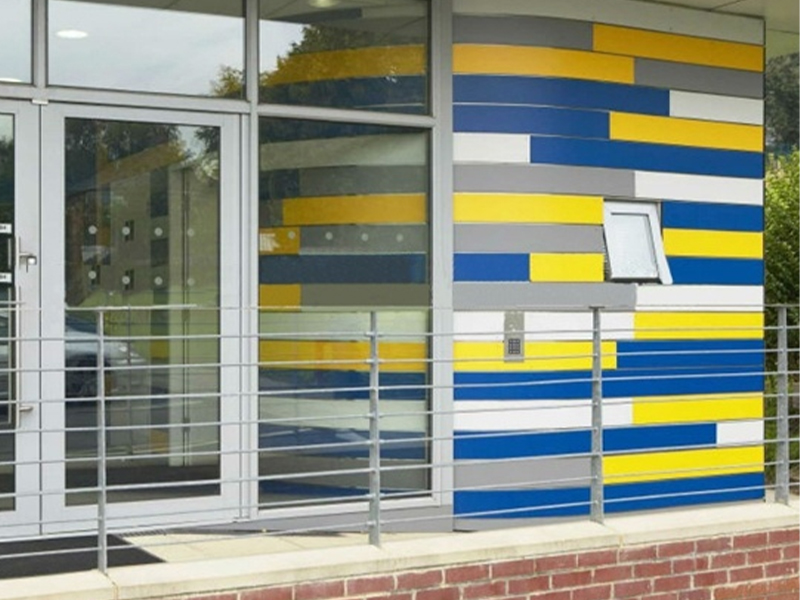
I. What are PVC Exterior Wall Cladding Panels? Analysis of Core Advantages
PVC exterior wall cladding panels are composite panels specifically designed for building facades. Their core structure combines a high-density PVC substrate with multiple layers of functional coatings. Taking the outdoor-specific model produced by TRSK as an example, a special EBC (Enhanced Barrier Coating) protective layer is added to the surface, achieving three times the weather resistance of ordinary panels through a high-temperature lamination process.
Laboratory data shows that for the panels treated with EBC, the color difference ΔE value is less than 1.5 after 1000 consecutive hours of ultraviolet irradiation, and the expansion rate is controlled within 0.08% after being soaked in boiling water for 48 hours. This characteristic enables it to withstand extreme temperature differences from -30°C to 80°C, making it suitable for use in areas with heavy rain, high humidity, or strong ultraviolet rays. Compared with traditional materials, its lifespan can reach more than 25 years, and it does not require frequent maintenance.
II. How Do New-Type Wall Panels Break Through the Limitations of Traditional Materials?
Traditional exterior wall materials such as anticorrosive wood, metal, or stone have problems such as easy corrosion, heavy weight, and high cost. PVC exterior wall cladding panels completely solve these pain points through three major innovations:
Upgraded Impact Resistance: It reaches an impact strength of 12kJ/m² (ASTM D256 standard), which can resist the damage caused by extreme weather such as hail.
Lightweight Design: Its density is only 1/4 of that of stone, reducing the load on the building structure and saving transportation and installation costs.
Waterproof Revolution: The water absorption rate in the 72-hour water immersion test is only 0.3%, which is far better than the national building curtain wall specification of ≤1%.
The surface Mohs hardness of TRSK products reaches 3H, which can effectively prevent scratching damage. At the same time, it supports customized decorative effects such as wood grain and stone grain, taking into account both aesthetics and practicality.
III. Core Technical Support for Professional-Grade Exterior Wall Systems
The manufacturing of high-quality PVC exterior wall cladding panels relies on several core processes:
Molecular Stabilization Technology: Nano-level UV absorbers are added to slow down the process of photoaging. After being tested under simulated natural climate conditions for 15 years, it still maintains 90% of its original performance.
Five-Layer Hot Pressing Process: It ensures that the density of the panel reaches 1.45g/cm³, and the bending strength exceeds 45MPa, meeting the requirements of high-rise buildings for wind pressure resistance.
Intelligent Drainage Structure: The three-dimensional water guide groove design achieves a drainage efficiency of 3L/m² per minute, preventing water accumulation and penetration.
TRSK adopts an environmentally friendly calcium-zinc stabilizer formula, achieving zero addition of heavy metals. The products have passed international certifications such as NEMA LD 3-2005 and EN 438-7:2005.
IV. Three Key Parameters for Scientific Selection
When choosing PVC exterior wall cladding panels, the following indicators should be focused on:
Thickness Selection: The commonly used range is 0.8-1.2mm. For residential projects, the 0.9mm balanced type is recommended, taking into account both strength and economy.
Size Adaptation: The specification of 1220 * 3660mm can minimize the splicing joints, and the extra-long panel of 1830 * 4270mm is suitable for the integrated design of high-rise curtain walls.
Fire Rating: For commercial buildings, products of B1 level (GB8624 standard) should be selected. TRSK panels have passed the vertical combustion test and have excellent flame-retardant performance.
For special climate areas, it is recommended to choose dark-colored panels (such as CHARCOAL DARK GREY). The surface temperature of these panels can be 5-7°C lower than that of light-colored panels, reducing the impact of thermal expansion.
V. The Installation Process Determines the Service Life
Professional construction needs to follow four major principles:
Base Treatment: The flatness error of the wall surface should be less than 3mm/2m. It is recommended to use self-leveling mortar for leveling.
Moisture-Proof Layer Laying: Install a waterproof and breathable membrane (moisture permeability rate ≥ 800g/m²/24h) to avoid erosion by condensed water.
Reserved Expansion Joints: Set 8-10mm deformation joints every 6 meters to deal with the effects of thermal expansion and contraction.
Fastening System: Use 316 stainless steel fasteners with a spacing of ≤400mm. In coastal areas, additional anti-salt fog treatment is required.
TRSK recommends the "rain screen principle" installation method. By creating an air circulation layer, it can reduce the internal humidity of the wall by 60%. Engineering cases show that this method can extend the service life of the system by 8-10 years.
VI. Environmental Protection Value and Sustainable Development
Modern buildings have increasingly strict requirements for the environmental protection of materials:
Low-Carbon Attribute: The carbon footprint throughout the entire life cycle is only 32kgCO2/m², which is 1/5 of that of natural stone.
Recycling and Reuse: It supports 100% mechanical recycling, and the performance retention rate of recycled materials reaches 85%.
Energy Saving Benefits: Light-colored panels can reduce the surface temperature of the building by 7-9°C, reducing air conditioning energy consumption by 12%.
TRSK products have added points for LEED certification. They use water-based ink for printing during the production process, and the VOC emission is lower than 0.1mg/m³, meeting the environmental protection standards of the European Union.
VII. Innovative Application Scenarios and Successful Cases
PVC exterior wall cladding panels have broken through the traditional building field:
Coastal Buildings: In a tropical resort hotel project, after 8 years of erosion by sea wind and salt fog, the panels have no cracks or deformation.
Renovation of Historical Buildings: It precisely replicates the traditional wood grain texture and has been adopted by cultural relic protection departments in many places.
Industrial Factories: After the renovation of the exterior wall of a chemical factory, there has been no corrosion record within 3 years, and its acid and alkali resistance is outstanding.
TRSK's latest developed photovoltaic integration system integrates solar panels through hidden card slots, achieving the power generation function of the building's skin, and has been successfully implemented in green park projects.
Through comparative analysis, it can be seen that PVC exterior wall cladding panels, with their excellent weather resistance, environmental protection, and economy, are reshaping the industry standards for building exterior walls. As a technological leader, TRSK provides solutions that balance aesthetics and functionality for global customers through continuous innovation. Whether it is a new project or a renovation project, choosing a professional-grade PVC exterior wall system is a wise choice to enhance the value of the building.


Recent News
1.What are the types of Exterior wall cladding?
2022-07-062.What are the characteristics of Exterior wall cladding?
2022-08-103.What are the types of external wall cladding panels?
2022-08-254.What are the functions of Exterior wall cladding?
2022-10-265.What are the exterior cladding panels?
2022-11-036.Why external wall cladding panels?
2024-07-017.Why Choose PVC Exterior Wall Cladding Panels?
2025-01-06