






Why HPL Sheets Are the Go-To Choice for Busy Commercial Spaces
 Oct 30, 2026|
 View:4
Busy commercial spaces need surfaces that can handle daily wear and tear. Scuffs, moisture, and constant cleaning wear down normal finishes fast. Many surfaces look worn after only a few months of use. HPL sheets meet this challenge with a rare mix of durability, design range, and cost-effectiveness.
Contractors, designers, and business owners all face the same question: which material holds up without sacrificing looks? High-pressure laminate gives a practical answer. It resists impact, moisture, and repeated cleaning while keeping a finished appearance. Specifiers who choose HPL sheets gain surfaces that protect long-term value in entrances, hallways, counters, and shared areas.
Key Takeaways
HPL sheets resist scratches, moisture, and heavy use, so they last a long time in busy places.
You can choose from many designs, like woodgrain or solid colors, to match your brand.
HPL sheets save money because they cost less to install and need very little maintenance.
They offer good fire safety and resist chemicals, which keeps commercial spaces safer.
Use HPL sheets for tabletops, walls, and counters, but not for flooring unless you add a wear layer.
Why HPL Sheets Perform Under Pressure
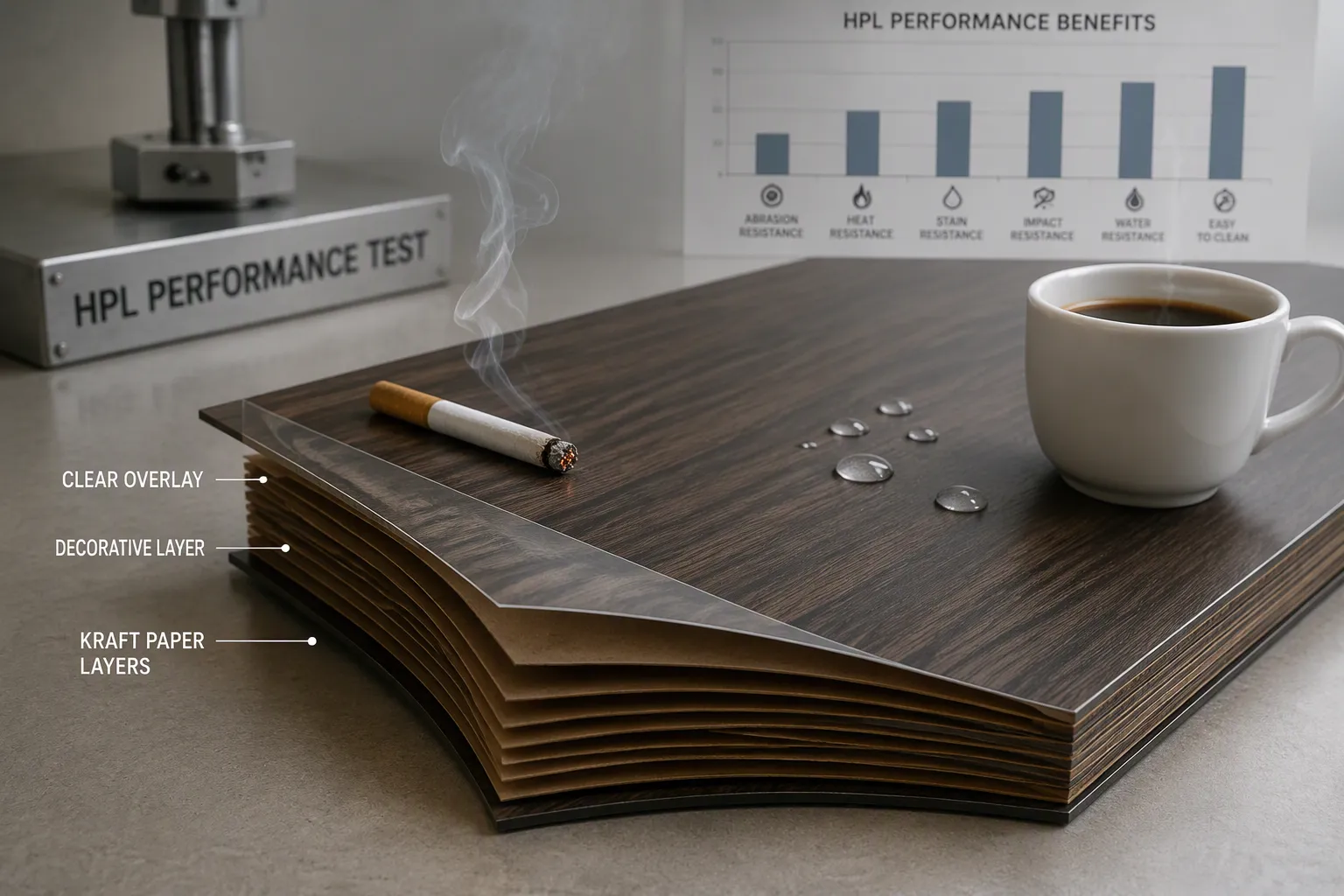
Contractors need materials that can take real-world abuse. The TRSK 4mm HPL sheet gives you that reliability through its engineered construction. Several layers of Kraft paper soaked in phenolic resin make up the dense core. A decorative paper with the woodgrain pattern sits on top of that core. A clear protective overlay filled with melamine resin covers the stack. These layers bond under high pressure and temperature, hardening into one solid, non-porous panel. This multi-layer build gives the sheet its strength, impact resistance, and ability to resist moisture and heat.
Resilience and Wear Resistance
The construction leads directly to measurable performance. The phenolic core gives structural rigidity and dimensional stability. The melamine overlay provides scratch and abrasion resistance while staying clear to protect the printed design. Each resin-impregnated layer adds strength, and the overlay takes the first hits from daily use.
Independent testing confirms this durability. The TRSK 4mm sheet meets NEMA LD 3-2005 and EN 438-7:2005 standards. Test results show resistance to cigarette burns, impact, cracking, dry heat, abrasion, and boiling water. The abrasion resistance reaches 870 revolutions, far above the 350-revolution minimum. Tensile strength measures 63 MPa against a 55 MPa requirement. The sheet passes every test with room to spare.
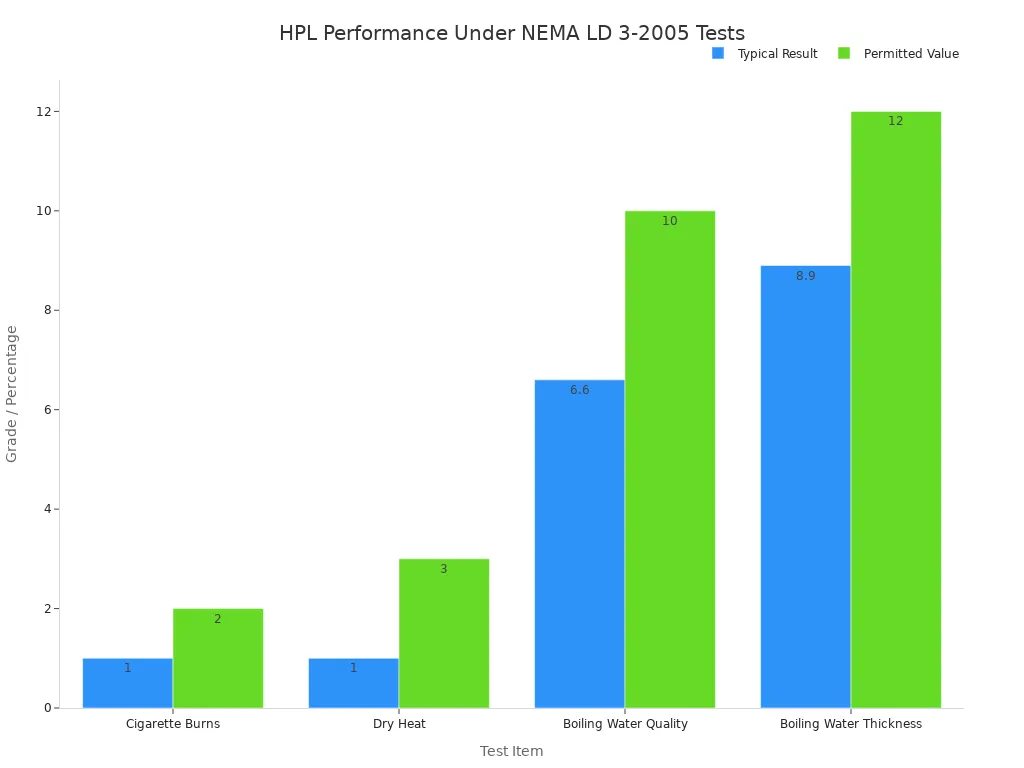
The chart above shows how typical results compare to permitted values. Cigarette burns leave no lasting mark. Dry heat causes no visible change. Boiling water adds only 6.6% to weight and 8.9% to thickness, both well within limits. These results mean the surface handles dropped tools, hot coffee cups, and spilled liquids without showing wear.
Design Flexibility and Low Maintenance
Durability means nothing if the surface looks outdated. HPL sheets offer a wide range of design options. Woodgrain finishes give a natural, sophisticated look. Marble patterns, stone textures, solid colors, metallic finishes, and fabric textures add even more choices. Matte surfaces cut glare, and anti-fingerprint finishes keep busy areas looking clean.
Matte, woodgrain, solid-color, and anti-fingerprint HPL are popular choices for modern office furniture, with the best finish depending on the design and application.
The TRSK 4mm sheet has a textured woodgrain finish at 2440x1220mm dimensions. This size covers standard countertops, tabletops, and wall panels with few seams. The 4mm thickness gives excellent dimensional stability, so panels stay flat and true even in large installations.
Maintenance stays simple. A liquid cleaner and a sponge remove most blemishes. A microfiber cloth or glass cleaner handles routine wiping. The non-porous surface resists stains and heat, so regular cleaning takes minutes rather than hours. Compared to solid surface materials, HPL offers better wear resistance, low heat conduction, and the most economical option among typical surface materials. Contractors who specify this material save clients money on both installation and long-term upkeep.
The mix of tested resilience and design flexibility makes HPL the practical choice for demanding commercial environments. Contractors can specify it knowing the surface will perform under pressure while keeping its appearance for years.
Advantages for High-Traffic Commercial Spaces
Cost-Effectiveness and Easy Cleaning
Contractors who pick materials for busy buildings watch two numbers: the install price and the cost of keeping the surface usable. HPL sheets win on both. Panels handle heavy use for decades without replacement. That durability turns into big long-term savings. Scratches, impacts, and daily wear do not force early repairs, so maintenance budgets stay predictable. Installation costs often run lower than traditional materials because the panels are lightweight and mount efficiently. The starting price of $30–$100 per square meter looks modest once a contractor weighs it against minimal upkeep and an extended lifespan.
Cleaning adds another layer of savings. Routine care of HPL surfaces usually needs only mild soap and water. Crews should avoid abrasive cleaners and scouring pads. For stubborn stains, manufacturer-recommended cleaners do the job. Regular maintenance keeps the surface looking good and working well for years. Resistance to chemicals and easy cleaning further lower operating costs over time. Compared with natural wood, which needs frequent maintenance and fights moisture and pests, HPL demands far less attention. Compared with metal, it costs less, weighs less, and cuts transport and installation effort. Compared with plastic laminates, it lasts longer and creates fewer replacement cycles.
Fire Safety and Chemical Resistance
Fire performance deserves careful attention in any commercial specification. Phenolic resin in fire-resistant HPL forms a carbon-rich char when exposed to intense heat. That char slows flame spread and reduces material breakdown. Contractors should remember one rule: fire resistant is not fireproof. Actual performance depends on panel thickness, installation details, ventilation, and nearby materials. Qualified laboratories test samples for flame spread, smoke development, ignition resistance, and heat release. Results should match the final wall, door, or furniture assembly.
Several standards govern these ratings. EN 13501-1 in Europe measures reaction to fire plus smoke and flaming droplets, with top classes ranging from A1 and A2-s1,d0 down to F. GB 8624 in China classifies combustion performance as A, B1, B2, or B3. ASTM E84 and NFPA methods in the USA express surface flame-spread and smoke-developed indices as Class A, B, or C, with Class A the most demanding interior-finish classification. No single fire rating covers every HPL product. Contractors should always request the test certificate and check it against local building codes.
Chemical resistance rounds out the package. The thermoset resin system forms a hard, stable surface. It tolerates mild detergents, household cleaners, disinfectants, mild acids, mild alkalis, and alcohol-based cleaners well. Strong solvents, strong acids, and strong alkalis can damage the finish, so crews should avoid direct contact with them. Most diluted disinfectants are compatible with HPL, but prolonged exposure may affect the surface. Following the product's care guidelines protects the investment.
How HPL Sheets Compare to Other Surfaces
Outperforming TFL and Solid Surfaces
Contractors compare surfaces by wear, cost, and how long they last. The hpl sheet beats thermally fused laminate on every durability measure. TFL presses decorative melamine paper right onto a substrate. HPL fuses melamine surface papers and phenolic-treated core papers under high heat and pressure into a thermoset sheet, then bonds that sheet to a substrate. That extra core layer gives HPL the best scratch, wear, and impact resistance in its category. TFL scores much lower on all three. TFL still works for vertical, low-traffic jobs like cabinets and closet parts. HPL fits horizontal, high-wear surfaces like countertops, desks, and workstations.
Factor | HPL | Solid Surface |
|---|---|---|
Installed cost | $20–$60/sq ft | $50–$150/sq ft |
Repairable | No | Yes |
Lifespan | 10–20 years | 20–50 years |
Heat resistance | Limited | Moderate |
Solid surface costs much more to install. It also wins on repairability. Scratches and small burns sand out because the color runs through the slab. HPL cannot be fixed once the decorative layer gets a deep scratch or heat mark. Replacement is the only option. Contractors weigh that trade-off against budget and traffic level.
Where Alternatives Fall Short
Quartz brings excellent scratch resistance at Mohs 7. It also brings problems in long commercial runs. Quartz seams are mechanical joints filled with epoxy. Even the best seams stay visible on close inspection. A 24-ft nurse station needs two or three seams, and a 40-ft cafeteria line needs four or more. Each seam becomes a possible failure point where moisture and bacteria collect. Quartz also cannot be cut or trimmed on-site with standard tools. Field work requires wet cutting with specialized equipment.
Solid surface scratches more easily than quartz, at Mohs 2–3. HPL sits at Mohs 4–5, and TFL at Mohs 3–4. Quartz and solid surface both carry moderate heat risk near 300°F. HPL and TFL rate low to moderate. Contractors who specify for busy spaces balance these limits against cost, weight, and installation speed.
Choosing the Right HPL Sheet
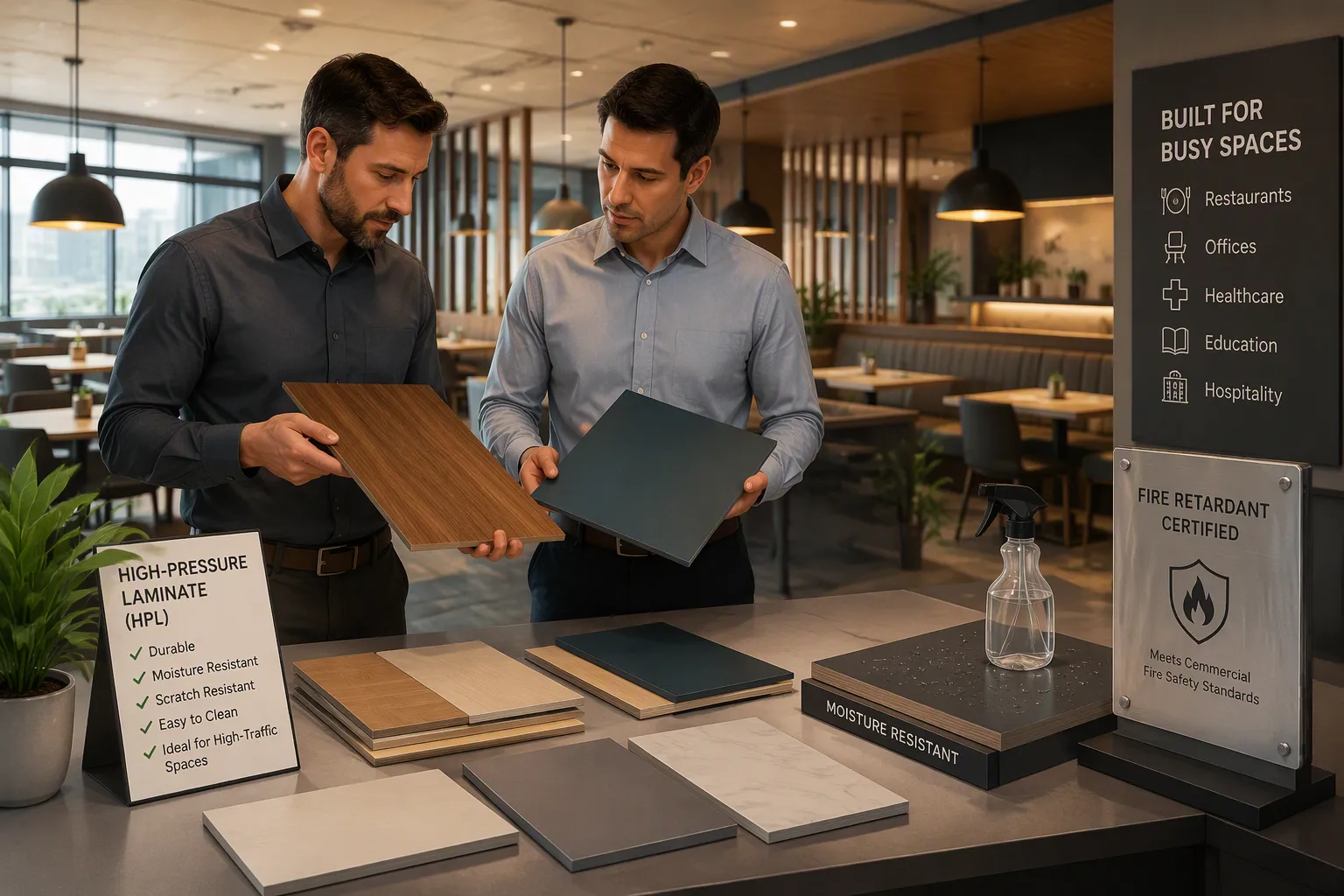
Contractors have many choices when picking surfaces for commercial interiors. The right high-pressure laminate depends on matching the material to what the space needs. Each project has different priorities. A restaurant needs different qualities than a corporate office. Knowing the key factors helps contractors make confident choices.
Functionality, Aesthetics, and Moisture Resistance
Functionality comes first in busy areas. Contractors should choose strong, scratch-resistant sheets for high-traffic zones. The TRSK 4mm sheet meets this need well. Its tested resistance to abrasion, impact, and dry heat makes it a good fit for restaurants, shops, and offices. These spaces get constant use. The surface must hold up without showing wear.
Aesthetics matter just as much. Designers pick hues, textures, and patterns that match brand identity. Woodgrain finishes offer a natural look. Solid colors give clean, modern lines. The right choice creates a mood that reflects the business. Contractors can match the laminate to the feeling each room should have.
Factor | What to Consider When Selecting HPL Sheets |
|---|---|
Functionality | Choose strong, scratch-resistant sheets for high-traffic areas. |
Aesthetics | Select hues, designs, or textures that complement brand identity. |
Moisture Resistance | For kitchens or bathrooms, make sure the sheet is moisture-resistant. |
Fire Safety | Choose fire-retardant options if fire safety is a major concern. |
Sustainability | Ensure sustainability by using environmentally friendly products. |
Moisture resistance deserves special attention. The non-porous surface stops water from soaking in. This quality lowers the risk of warping or swelling. Kitchens, bathrooms, and entryways all benefit from this protection. The laminate also stands up to UV rays and temperature changes without fading or breaking down. These properties make hpl sheets great for areas with humidity risks.
Fire Safety and Sustainability
Fire safety remains a critical specification point. Contractors should look for Class A fire ratings under ASTM E84. This rating shows flame spread around 10 and smoke developed around 95. These numbers fall within Class A thresholds. Building codes require this level for exit enclosures, corridors, and most public areas. Contractors must confirm the surface burning rating. They should not confuse it with assembly fire-resistance ratings.
Sustainability certifications show responsible manufacturing. Contractors should ask for several key documents:
ISO certifications – ISO 9001 for quality, ISO 14001 for environmental management, and ISO 45001 for occupational health and safety.
Environmental Product Declaration (EPD) – An independently verified document that shares life-cycle environmental impact.
FSC Chain-of-Custody – Traces forestry-based paper content from responsible sources.
SCS Global Services Recycled Content Certification – Measures pre- and post-consumer recycled content percentages.
Health Product Declaration (HPD) – Reports product contents and related health information.
These certifications support LEED, WELL, and Living Building Challenge credits. GREENGUARD Gold certification and TSCA Title VI formaldehyde compliance matter for schools and healthcare facilities. Contractors who check these credentials give their clients better long-term value.
Practical HPL Applications in Commercial Interiors
Interior and Exterior Use Cases
Contractors use HPL on many kinds of commercial surfaces. It works well for tabletops, wall panels, countertops, work surfaces, and furniture. Reception desks and countertops often use postforming laminate to get curved edges. Phenolic HPL is a good fit for work surfaces in tough commercial interiors.
Application | Commercial Interior Context |
|---|---|
Tabletops | Widely used in commercial interiors |
Common commercial interior surface | |
Countertops and work surfaces | Postforming laminate for counters and reception desks; phenolic HPL for work surfaces |
High-traffic areas | Phenolic HPL recommended for demanding environments |
Specifiers should know one limit: the sheet does not work for flooring unless you add a wear layer on top. Curved work also needs planning. Any curve with a radius under 23 cm (9 inches) will probably crack. Crews should clean and square the substrate first, then apply adhesive to both faces and start on the flat section. A J-roller then presses the sheet over the curve. Postforming laminate bends further, with an inner radius of about 8–10 times the laminate thickness. Shops reheat it to about 325°F before rolling the edge.
Gates and High-Wear Zones
Gates, boundary walls, and parapet walls show what the material can handle outdoors. Manufacturers list these spots as good exterior high-wear settings. The surface resists scratches, abrasion, impact, and weather. High UV stability keeps the finish from fading in direct sun. The panel also handles extreme temperatures and precipitation without cracking or staining. Maintenance stays low, which suits contractors who hand buildings over to busy facility teams.
HPL sheets earn their spot in busy commercial spaces because they are proven to last, come in many designs, need little upkeep, save money, and offer dependable fire safety. These benefits add up over time. The surfaces resist scuffs, moisture, and constant cleaning, so facility teams replace them much less often. Contractors who choose hpl get budgets they can predict and clients who are happy.
TRSK (Jiangsu TRSK New Material Co., Ltd., founded 1998) is ready to be a trusted supplier. The company's tested 4mm sheets give contractors and designers a dependable choice for demanding interiors. Projects that plan ahead deserve surfaces that keep their looks and their value for years.
FAQ
What thickness and sheet size should contractors specify for commercial work?
The TRSK 4mm HPL sheet comes in a standard 2440x1220mm size. This thickness gives good dimensional stability for tabletops, wall panels, and countertops. Contractors can cover most standard surfaces with few seams. The panel stays flat and true in large installations.
Does a 4mm HPL sheet work for commercial flooring?
No. The 4mm sheet does not suit flooring unless the installer adds a wear layer on top. Contractors should reserve it for tabletops, wall coverings, countertops, and furniture. Flooring demands a dedicated product built for foot traffic.
Which standards should a specifier check before approving an HPL sheet?
Contractors should confirm the sheet meets NEMA LD 3-2005 and EN 438-7:2005. These standards cover resistance to cigarette burns, impact, cracking, dry heat, abrasion, and boiling water. A supplier who provides test certificates gives the project a verifiable performance record.
Can crews bend HPL sheets around curved surfaces?
Yes, within certain radius limits. The sheet glues to curved surfaces inside those limits. Postforming laminate offers greater flexibility for tighter curves. Crews should plan the bend before cutting and follow the supplier's radius guidance.
How does a contractor confirm reliable supply for a large project?
TRSK (Jiangsu TRSK New Material Co., Ltd.) has manufactured HPL since 1998 and employs over 200 people. The company packs each sheet in seaworthy wooden crates, with 12 packages per 20' container. Contractors gain predictable delivery for scheduled installations.