






HPL Laminate Sourcing Guide: Certifications, Packaging, and Container Loading for Wholesalers
 Oct 09, 2026|
 View:15

Before you place a bulk HPL order, lock down three sourcing priorities. First, check certifications. Following the rules protects your access to markets. Second, confirm transit-grade packaging. This packaging protects your profit margin. Third, approve an optimized container loading plan. Smart loading protects your freight costs. This hpl laminate sourcing guide gives you step-by-step checks and reusable checklists. You can use them right away during supplier evaluation. Each priority works as a cost and risk control lever. Skip one, and you take the loss. Treat all three as non-negotiable gates before you commit to any purchase order. Strong suppliers welcome these checks. Weak suppliers dodge them.
Key Takeaways
Check the supplier's certifications first to prove quality and safety.
Make sure the packaging is strong to protect your profit during shipping.
Approve a smart plan for loading containers to lower freight costs.
Weigh and report the VGM correctly to avoid delays and fines.
Finish all shipping papers before the container doors shut.
HPL Laminate Sourcing Guide: Certifications
Certifications are your proof. They turn what a supplier says about its performance into facts you can check. You need this proof for quality, fire safety, hygiene, emissions, and outdoor use. Without paper, a claim is just a promise. This part of the hpl laminate sourcing guide shows you which documents to ask for and how to test them.
Core Certifications to Request
Start with management systems. ISO 9001 covers quality management. ISO 14001 covers environmental management. Both show a supplier runs disciplined processes. Next, ask for the core product standards for your market.
Region | Certification | What it covers |
|---|---|---|
EU | EN 438 | Core HPL quality and performance standard |
EU | EN 13501-1 | Reaction-to-fire classification (Euroclasses) |
EU | EN 438-6 | Exterior weathering grade |
EU | E1 / E0 | Formaldehyde emission classes |
North America | NEMA LD 3 | HPL performance and grade classifications (US/Canada) |
North America | ASTM E84 / NFPA | Fire testing (e.g., Class A) |
North America | CARB Phase 2 / TSCA Title VI | Formaldehyde emissions |
Global/International | ISO 4586 | International HPL standard (mirrors EN 438) |
Global/International | ISO 22196 | Antibacterial activity (healthcare, labs, food areas) |
Add CE marking where the law requires it. Ask for CARB and GREENGUARD or low-VOC certificates for projects that are sensitive to emissions. Request Class B1 fire safety certification for high-risk spaces. A solid supplier guide names these standards clearly. TRSK (Jiangsu TRSK New Material Co., Ltd.) holds ISO 9001 and ISO 14001 certification and reports a Class B1 fire rating on its High Pressure Laminate line. Treat that as a starting benchmark, not a finish line.
Quality and compliance in the North American market should align with standards such as ASTM, ANSI, and LEED to ensure product consistency and regulatory compliance.
Verification Steps and Red Flags
Paper alone proves nothing. Check every certificate before you sign.
Ask for full certificate copies, not screenshots.
Check the issuing body and the validity dates.
Compare the scope with the exact product you ordered.
Confirm test reports for physical, chemical, climatic, and fire-retardant properties.
Build these checks into your supplier evaluation checklist. They form the backbone of any serious supplier qualification process. Watch for these red flags:
Expired certificates
Scope mismatches between certificate and product
Refusal to share test reports
Vague claims with no standard numbers
One weak document can cost you a market. Check first, order second.
HPL Packaging Standards for Transit
Packaging protects your profit. Poor packaging turns a good order into a complaint. This part of the guide covers export packing specs, protection methods, and labels.
Material Specs and Protection
Set the board grade for export packing. Ask for corner protectors, edge guards, and a moisture barrier wrap. Pallets must hold up under ocean freight loads. HPL sheets come in 4′ and 5′ widths with various lengths, and thickness runs from 5.5 mm (1/4″) to 1-1/4″. Thin sheets bend more, so plan packaging around the size and thickness you order. Match packaging to sheet size before you book freight.
Control movement, moisture, and condensation during long transit. Use this table as your packaging checklist.
Concern | Protective Measure |
|---|---|
Moisture | Keep loads sheltered from rain, humidity, and dirty environments |
Moisture | Store sheets off the floor on pallets or racks |
Moisture | Keep sheets in original packaging until fabrication |
Moisture | Use dehumidification or climate control where seasonal humidity fluctuates |
Impact | Secure loads with clean straps, padding, and stable supports |
Impact | Prevent contact with sharp metal edges or abrasive objects |
Impact | Fit corner protectors and edge guards for long-distance handling |
Impact | Support packs across full length and width |
During vehicle transport, sheets should stay steady and supported across the full length and width of the pack. Planning should focus on both safety and surface protection, since sudden braking and repeated vibration cause edge wear and packaging breakdown.
Apply moisture controls at every stage. Good moisture controls stop moisture and damage before it starts. Inspect packaging at each handoff.
Labeling and Handling
Label every pack with product name, size, thickness, batch, quantity, handling symbols, and destination marks. Clear labels speed up customs and cut handling errors. Packaging labels must hold up through humidity and rough handling. Wood pallets need the ispm 15 mark for export packing. Check the ispm 15 mark on each pallet before loading. A missing ispm 15 mark can stop your shipment at the border.
Ask packaging suppliers for sustainability certifications. FSC and PEFC confirm responsible forest sourcing. FSC Chain of Custody supports LEED projects. GREENGUARD supports indoor air quality claims. These certificates make your export packing story stronger.
Container Loading for HPL Shipments
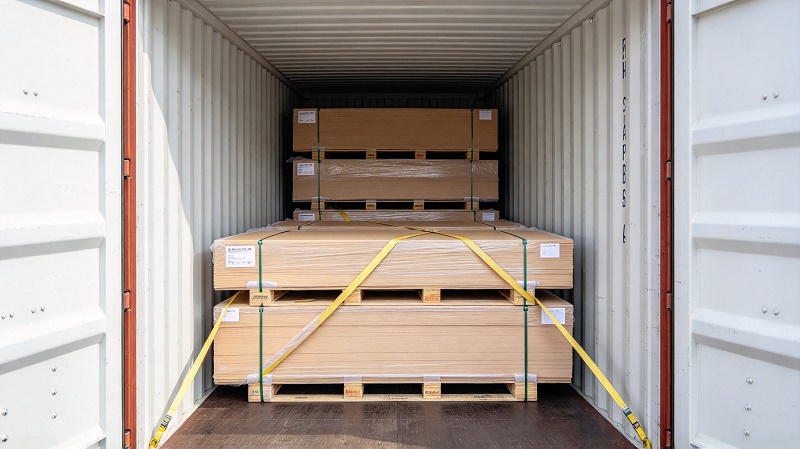
A good loading plan lowers freight costs and damage at the same time. You get the most out of container space when sheet sizes match container dimensions. Plan the stack order before the truck arrives. HPL sheets come in 4′ and 5′ widths with different lengths, and thickness runs from 5.5 mm (1/4″) to 1-1/4″. Customization options include cut-to-size, custom fabricated, full sheets or custom sizes, and fabricated parts. Every loading plan should start from these real dimensions, not from a catalog guess.
Professionally packed in export-standard wooden cases, with a precise layout to maximize container space. We waste no inch of space and firmly reinforce every shipment.
Loading Plans and Weight Distribution
Weight distribution protects the container payload and the road. An uneven load shifts the center of gravity and puts stress on the chassis. Check axle weight limits before you approve any loading plan. Keep the heaviest packs low and centered. A good load plan confirms pack orientation, height, and mass distribution before lifting, storage, and transport. Use measured pack layout, actual equipment limits, and receiving instructions. Confirm clearance, support, and handling before loading. This step belongs to the packing team and the logistics provider together.
Aspect | What must be considered | Required action |
|---|---|---|
Center of gravity | Pack orientation, height, and mass distribution affect stability | Use measured pack layout and actual equipment limits |
Upright pallet packing | Center of gravity, support, lifting equipment, height, receiver restraint | Confirm all factors before loading |
Flat-pack arrangement | Center of gravity, support, lifting equipment, height, receiver restraint | Confirm before loading |
Floor/load distribution | Contact length, point loads, center of gravity | Obtain an approved measured load-path drawing |
Support | Protection layers are not structural support | Ensure a confirmed load path |
Follow the joint IMO/ILO/UNECE CTU Code guidance for every container packing job. The CTU Code sets the baseline for safe packing, and your CTU code compliance protects the container payload. A clean, dry container is the first check. A clean, dry container also protects surfaces from condensation stains.
Securing and Inspection
Secure every pack with strapping, bracing, dunnage, and anti-slip materials. These four tools stop cargo shift on the road and at sea. Your load plan must show where each strap and brace sits. A written loading plan helps the crew repeat the same result on every shipment. The loading plan also supports the VGM figure you declare later. The VGM must match the real packed weight, so weigh as you load.
Station an inspector at the container doors during loading. This inspector catches issues buyers often skip: loose straps, crushed corners, and gaps in the stack. The goal is to prevent damage through loading and receiving. A second set of eyes on the container loading protects your margin. Review the container loading photos against the approved loading plan before the doors close.
Shipping & Documentation for HPL Orders
VGM Declaration Essentials
The verified gross mass (VGM) is the weight of the packed container, not just the goods inside. The shipper named on the carriage contract must arrange and submit the VGM in time for vessel planning. Work out the weighing method and submission deadline with your carrier and terminal. This step follows the IMO VGM requirements and the CTU Code. Your VGM declaration must match the real packed weight you measured during loading. A wrong figure delays the vessel and may lead to a fine.
The VGM connects directly to your loading plan. Weight distribution, axle limits, and center of gravity all feed the final number. Weigh as you load, then submit the VGM declaration before the cutoff. The CTU Code and your incoterms guide tell you who books and who declares. For general cargo this is routine. For class 8 dg sea freight, the VGM declaration needs extra care and earlier submission. Confirm the payload limit before you seal the doors.
Complete Documentation Checklist
Build your complete documentation checklist before the container leaves the yard. The packing list must show laminate lot numbers. Missing lot numbers is a common pitfall. It causes color-mismatch complaints on multi-phase projects. For US shipments, prepare CARB P2 documentation and check the TPC name on the certificate, not just the spec sheet claim. For EU shipments, include the CE declaration of conformity. Add FSC chain-of-custody documentation on request.
Document | Note |
|---|---|
Commercial invoice | Core shipping document |
Packing list | Must show laminate lot numbers |
Bill of lading | Core shipping document |
Certificate of origin | Core shipping document |
CARB P2 / CE declaration | Market-specific compliance |
VGM declaration | Matches packed weight |
Insurance documents | Covers transit risk |
Use a B2B sourcing checklist to screen suppliers on certifications, MOQ, lead times, quality control, and export experience. TRSK exports to Southeast Asia, Europe, and America, so its shipping & documentation process is well practiced. Good packaging and a clean complete documentation checklist protect your payload and your margin.
Treat sourcing as one single process. Check certifications first. Confirm packaging specs second. Approve the loading plan third. Finish shipping and documentation last. This hpl laminate sourcing guide gives you a path you can repeat.
Use the same pre-order checklist for every shipment:
Certificates checked against product scope
Packaging specs approved in writing
Loading plan signed off
VGM weighed, VGM declared
Documents complete before the doors close
Weigh the VGM as you load. Declare the VGM before cutoff. Match the VGM to the packing list. Write down every VGM you weigh. A wrong VGM delays the vessel. Build long-term accountability through documented audits, loading inspections, and shipment records. Enforce this hpl laminate sourcing guide every time.
FAQ
Which certifications should you check first?
Begin with ISO 9001 and ISO 14001. After that, ask for EN 438, CARB, and Class B1 fire papers. Look at who issued them, the dates they stay valid, and whether they cover your order. Weak packaging claims often sit behind strong certificates, so check both.
How do you make sure packaging can handle ocean freight?
Ask for board grade, corner protectors, edge guards, and moisture barrier wrap in writing. Match the packaging to sheet size and thickness, which runs from 5.5 mm (1/4″) to 1-1/4″. Confirm ISPM 15 marks on every pallet. Check the packaging at each handoff, then record the vgm and packaging notes after you weigh.
What makes a container loading plan safe and cost-effective?
Match sheet sizes to container dimensions and plan the stack order. Keep heavy packs low and in the center. Hold loads in place with strapping, bracing, dunnage, and anti-slip materials. Weigh as you load so the vgm matches the real weight. Good packaging helps at every step, and correct packaging data feeds the vgm.
Who submits the VGM, and when?
The shipper sets up and submits the vgm before the cutoff. Weigh the packed container as you load it. Confirm the method and deadline with your carrier. A wrong vgm delays the vessel. Keep packaging records with the vgm file, and check the vgm against the packing list.
What documents must be ready before the container doors close?
Get the commercial invoice, packing list, bill of lading, certificate of origin, and insurance documents ready. Add certification copies, test reports, and the vgm declaration. The packing list must show laminate lot numbers. File packaging specs, packaging marks, and packaging photos with the vgm record, and confirm they match the vgm.