






Why Choose HPL Cleanroom Panels for Chemical Resistance
 Nov 16, 2026|
 View:7
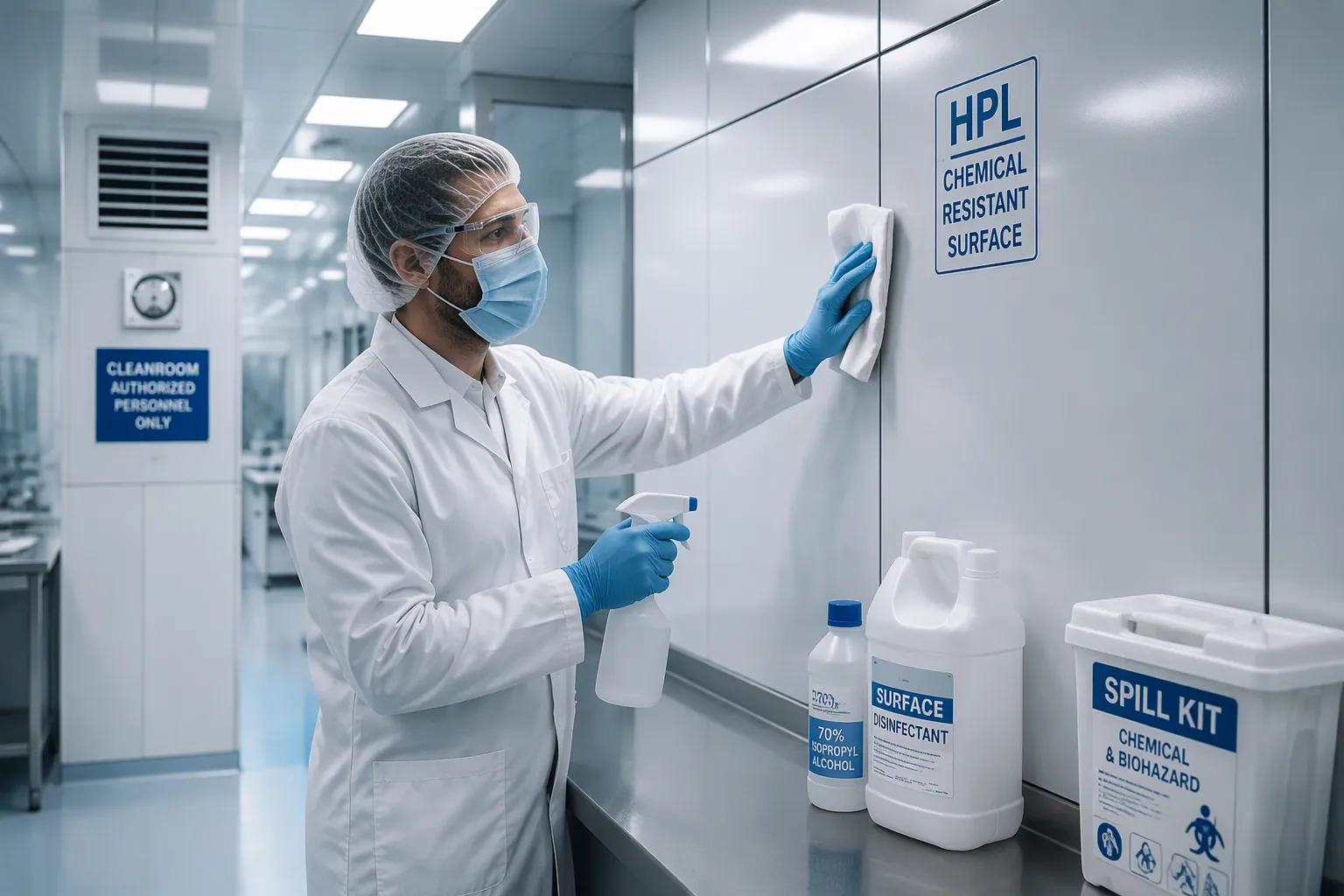
Every day, disinfectants, spills, and process chemicals attack your cleanroom surfaces. If you choose the wrong panel, you may get stains, blisters, delamination, or need to replace it early. That cycle drains your budget and disrupts production.
An HPL Cleanroom Panel breaks that cycle. It combines proven chemical resistance, cleanroom-grade hygiene, and long service life at a balanced cost. This guide answers your selection question through three proof pillars: how the material resists chemicals, how it compares fairly with alternatives, and how compliance and cost-benefit work in practice.
You get practical guidance here, drawn from Jiangsu TRSK's 24 years of High Pressure Laminate manufacturing experience.
Key Takeaways
HPL panels stand up to chemicals because their resin is fully cured and has no pores.
HPL panels are a good, balanced choice for most cleanroom walls. They resist chemicals well and give you design flexibility.
HPL panels meet important standards, such as a Class B1 fire rating and ISO certifications.
HPL panels save money over time because they last a long time and need little upkeep.
Pick the panel grade that works best with your strongest cleaning chemical to get the best protection.
How HPL Cleanroom Panels Resist Chemicals
Resin Curing and Non-Porous Surface
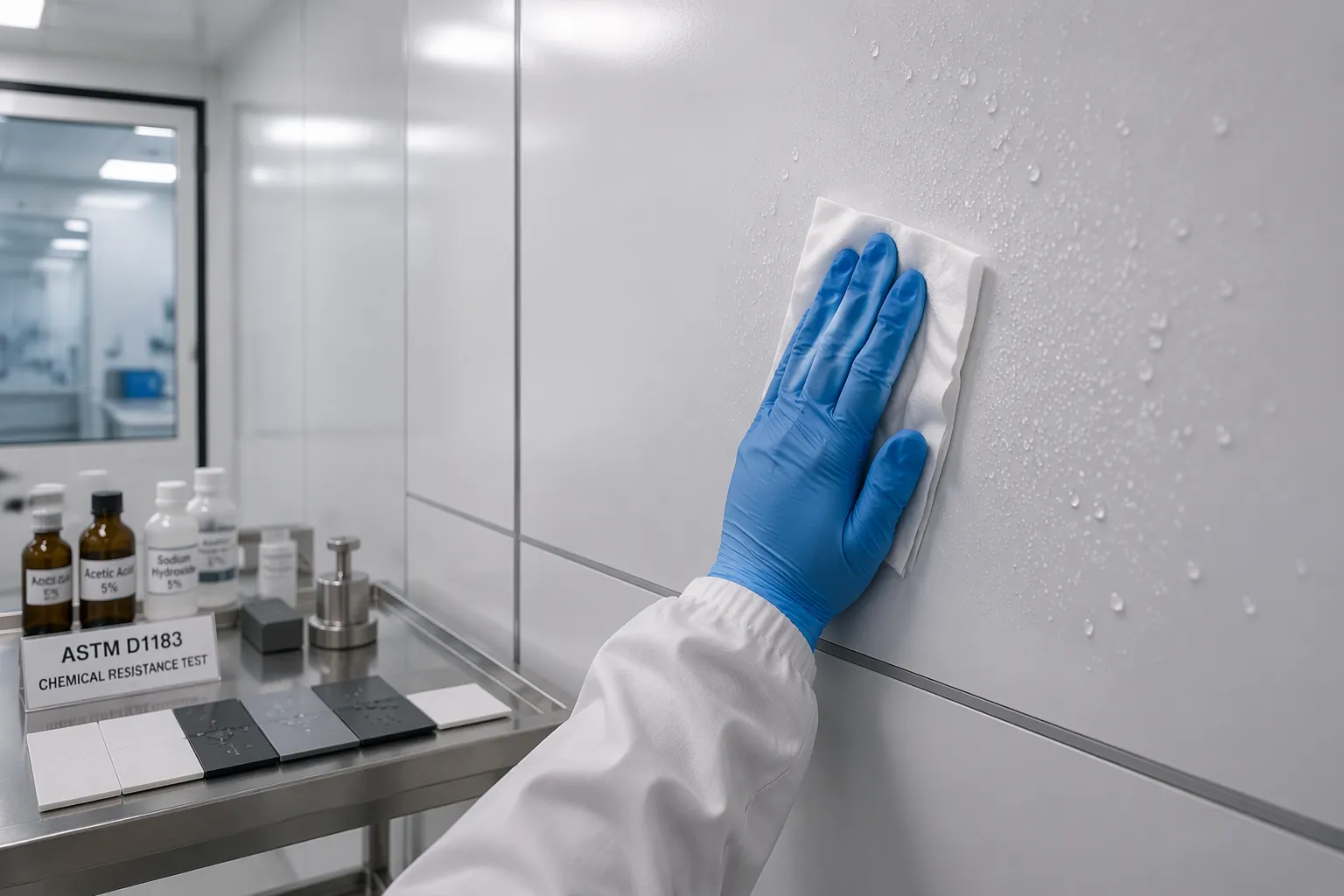
The chemical resistance of an HPL Cleanroom Panel begins inside the material, not on its coating. Manufacturers soak layers of Kraft paper with thermosetting resin. They then cure those layers under intense heat and pressure. The resin cross-links into a dense, chemically inert surface. This structure does not soften or dissolve when a disinfectant lands on it. The surface stays stable because the resin has already finished reacting.
You can check this resistance through ASTM D1183 testing. This standard exposes laminate samples to chemical agents and measures the effect. Panels that pass show resistance to acids, bases, solvents, and routine disinfectants. That range covers most of what a cleanroom throws at a wall. You will meet quaternary ammonium compounds, hydrogen peroxide blends, and alcohol-based wipes during daily sanitization. You may also face process chemicals from spills or splashes. A cured HPL surface handles these exposures without staining, blistering, or delamination.
Heat resistance adds another layer of protection. HPL withstands temperatures up to approximately 180–250 °C. Common thermoplastics such as PVC and ABS soften at much lower temperatures. A hot spill or a heat-generating process therefore poses less risk to HPL. The panel keeps its shape and its surface integrity under thermal stress.
The non-porous surface closes the final gap. Liquids cannot wick into the panel body. Chemicals stay on the surface until you wipe them away. This property also denies mold and fungus the moisture they need to grow. Enclosed cleanroom spaces with high humidity benefit most. A porous wall material traps moisture and feeds microbial growth. A sealed HPL face does neither.
Seam Integrity and Mold Resistance
Chemical attack often starts at the joints. A loose seam lets liquid travel behind the panel. It then sits in a dark, warm cavity and corrodes the substrate. HPL panels address this risk through tight seam construction. Installers join panels with sealants and profiles that close the gap. The joint becomes a continuous barrier rather than a weak point.
Mold resistance follows from the same logic. Fungus needs food, moisture, and a rough surface to colonize. HPL offers none of these conditions. The surface is smooth and non-porous. The seams stay sealed against condensation. You get a wall system that holds up in washdown zones, humid production halls, and sterile suites alike.
This combination of cured resin, tested chemical resistance, heat tolerance, and sealed joints explains why the material performs in demanding environments. Each layer of protection reinforces the next.
HPL Cleanroom Panels vs. Alternative Materials
Performance and Compliance Comparison
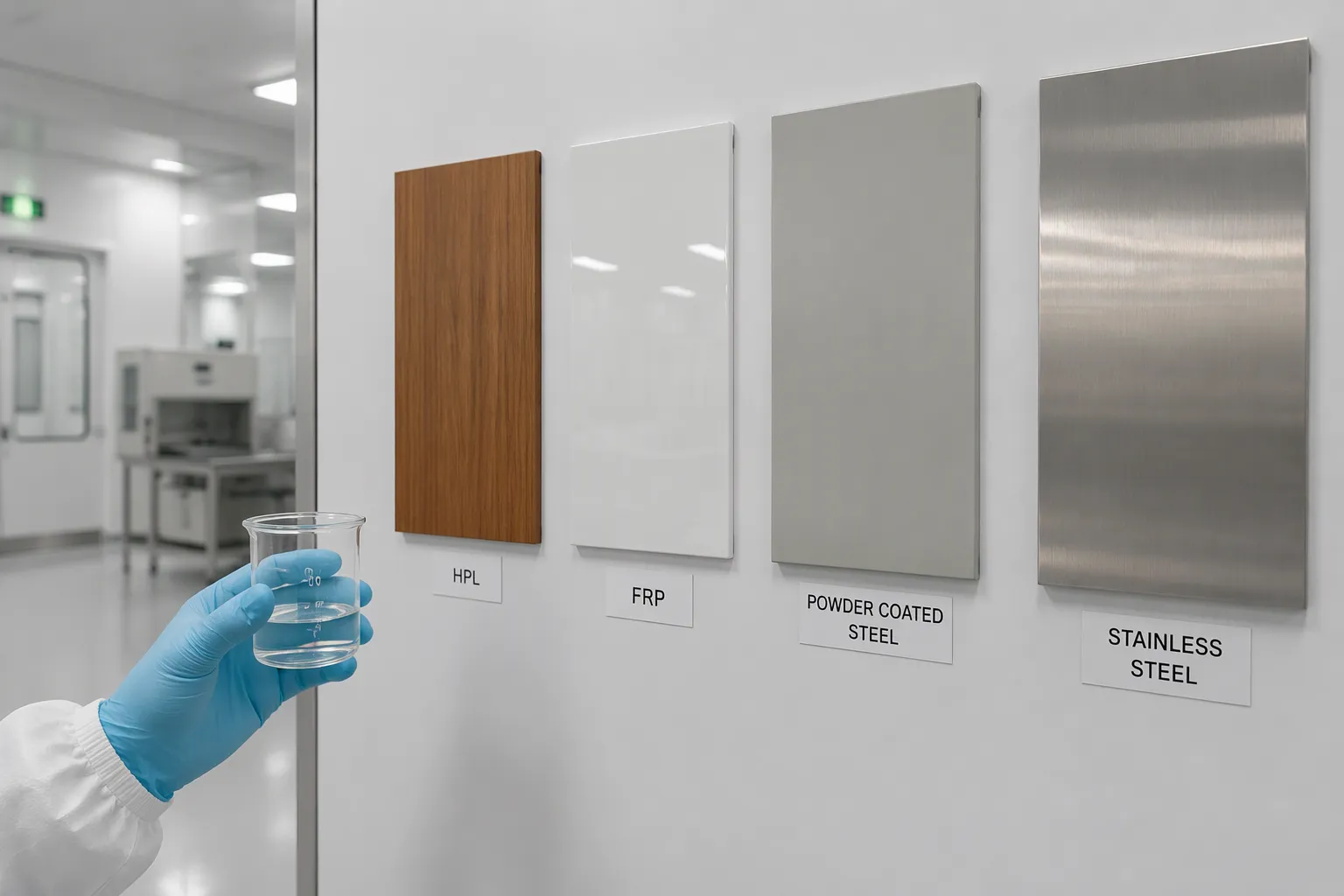
In a cleanroom, you have four common choices for walls and surfaces: HPL, FRP, powder-coated steel, and stainless steel. Each one acts differently when chemicals are present. The table below shows how they compare on the factors that guide your choice.
Factor | HPL | FRP | Powder-Coated Steel | Stainless Steel |
|---|---|---|---|---|
Chemical resistance | Cured thermosetting surface, tested to ASTM D1183 against acids, bases, and solvents | Good resistance to many acids and bases; performance varies by resin system | Coating resists mild cleaners; chips and scratches expose bare metal | Excellent against most process chemicals and washdown agents |
Heat tolerance | Up to roughly 180–250 °C | Moderate; depends on the resin formulation | Coating degrades under sustained high heat | Very high; suits steam and hot washdown |
Surface and hygiene | Non-porous, seamless when jointed, resists mold | Non-porous face; cut edges need sealing | Smooth while intact; damaged areas can trap soil | Non-porous and easy to sanitize |
Fire rating | Class B1 | Varies by product | Varies by core and coating | Non-combustible |
Design flexibility | Over 1,000 designs, including woodgrain, stone, and solid colors | Limited color range, often utilitarian | Limited to coating colors | Mill finish only |
Maintenance | Wipe-clean, low upkeep | Periodic inspection of seams and edges | Touch-up needed after impact | Frequent polishing to keep appearance |
Compliance works the same way. HPL is certified to ISO9001 and ISO14001 at the manufacturing level and meets the Class B1 fire rating. Stainless steel meets the strictest hygiene codes in high-risk zones. FRP and powder-coated steel meet cleanroom requirements when you choose the right grade and detailing.
Where Each Material Fits Best
A fair choice starts with the actual demands of your room. Stainless steel is the right pick for high-heat washdown areas, like sterile processing and food-contact zones. It handles steam and strong cleaning cycles that would stress other surfaces. Powder-coated steel fits dry spaces driven by budget, such as storage rooms and utility corridors, where chemical exposure stays mild. FRP works well in certain wall systems, especially where a continuous molded surface and moderate chemical load matter more than design choice.
An HPL Cleanroom Panel covers the wide middle ground. You get chemical resistance that handles routine disinfectants and process spills. You also get design flexibility that metal and FRP cannot match, so wall surfaces blend with the rest of your facility. Cleanability stays high because the surface is non-porous and the seams stay sealed. Maintenance stays low because the color runs through the panel instead of sitting on a coating that can chip. A density of at least 1450 kg/m³ and water absorption of 8% or less keep the panel stable in humid rooms.
That balance explains the appeal. You do not pay for stainless steel on every wall. You do not accept coating damage in a room full of chemicals. You match the material to the exposure, and HPL covers most of it.
Jiangsu TRSK High Pressure Laminate in Cleanroom Applications
Pharmaceutical, Laboratory, and Healthcare Settings
Jiangsu TRSK makes two product lines that work well in these rooms. The High Pressure Laminate line is for general cleanroom walls, casework, and partitions. The Chemical Resistant Laminate line is for places with heavier exposure, like labs, hospitals, drug-making suites, and beauty salons. Both lines use the same cured thermosetting structure, so you get steady performance across a facility.
Drug-making spaces need GMP-grade surfaces. A GMP-grade surface must handle repeated chemical exposure without fading, blistering, delamination, or breakdown. You will wipe these walls with disinfectants shift after shift. You will also face spills during mixing and cleaning. TRSK laminate keeps its surface through these cycles. The color is in the panel body, so it does not wear away with each wash. The bond between layers stays strong, so the panel does not peel at the edges.
The same features suit hospitals and labs. You get a Class B1 fire rating for safety. A density of at least 1450 kg/m³ gives the panel stiffness and impact strength. Water absorption of 8% or less keeps dimensions stable in humid rooms. These properties also help in semiconductor and dry-lab settings, where surface stability and low particle shedding matter.
Matching Laminate Grades to Chemical Exposure
Grade selection starts with a simple question: what touches the wall? For routine disinfectants and mild cleaners, the standard High Pressure Laminate line works well. For strong acids, bases, or solvent-heavy processes, move up to the Chemical Resistant Laminate line. Match the grade to the strongest agent in your cleaning protocol, not the average one.
Customization helps with this matching work. TRSK offers OEM/ODM service for size, color, and branding. The catalog has over 1,000 designs, so you can pick a surface that meets both your chemical needs and your facility's look. Check your exposure list with the TRSK team before you finalize the order. A sample test against your actual disinfectant takes out the guesswork. That step protects your HPL Cleanroom Panel investment for the full service life.
Standards, Certifications, and Cost-Benefit
Cleanroom Standards and Certifications
Certifications let you check claims before you buy. Jiangsu TRSK holds ISO9001 for quality management and ISO14001 for environmental management. These certifications show that the factory follows written processes for consistency and environmental control. You can ask for the certificates during supplier review and keep them with your project records.
Chemical performance depends on test evidence. TRSK tests its laminate to ASTM D1183, the standard that exposes samples to chemical agents and measures the effect. Passing results confirm resistance to acids, bases, solvents, and routine disinfectants. The panels also carry a Class B1 fire rating, which supports safety planning in occupied buildings. Ask for test reports that match your actual cleaning agents. A report tied to your disinfectant list tells you more than a generic data sheet.
Lifecycle Cost and Value Analysis
Initial price tells only part of the story. Compare the full service life instead. A cheap panel that stains or delaminates forces early replacement, and each replacement brings labor, downtime, and disposal costs. An HPL Cleanroom Panel resists those failures, so it stays in place far longer. The color runs through the panel body, so scratches and wear do not expose a different surface underneath.
Maintenance adds to the savings. You clean the surface with standard disinfectants and routine wiping. You do not repaint, re-coat, or polish. You also avoid patching chips, a common repair task on coated metal. TRSK supports these claims with testing for physical, chemical, climatic, and fire-retardant properties. Density of at least 1450 kg/m³ and water absorption of 8% or less keep the panel stable through humid cycles. Add up durability, low upkeep, and fewer replacements, and the lifecycle value clearly outweighs the initial price gap.
You now have three strong reasons to pick an HPL Cleanroom Panel. The resin-filled build gives you proven chemical resistance. The material balances hygiene, durability, and compliance without giving anything up. Strong lifecycle value keeps replacement costs low over the years.
Match your panel grade to your real chemical exposure and cleanroom class. HPL covers a wide range of common cleanroom needs, so most rooms fit within the standard or chemical-resistant lines.
Take the next step with confidence. Contact Jiangsu TRSK's team for grade selection, sample testing, and guidance for your project. Confirm HPL fits your application before you commit.
FAQ
How do I confirm a panel resists my specific disinfectant?
Ask for ASTM D1183 test results and compare them against your cleaning agent list. This standard exposes laminate samples to chemicals and measures the effect. TRSK can also test a sample against your actual disinfectant. That step removes the guesswork before you place an order.
Which laminate grade suits a room with strong acids or solvents?
Move up to the Chemical Resistant Laminate line for strong acids, bases, or solvent-heavy processes. The standard High Pressure Laminate line handles routine disinfectants and mild cleaners well. Match the grade to the strongest agent in your protocol, not the average one.
Does HPL meet cleanroom fire safety requirements?
Yes. TRSK HPL carries a Class B1 fire rating, which supports safety planning in occupied buildings. The panels also hold ISO9001 and ISO14001 certification at the manufacturing level. Ask for the certificates and test reports during supplier review, and keep them with your project records.
Can I customize panel size, color, and branding?
Yes. TRSK offers OEM/ODM service for size, color, and brand logo. The catalog includes over 1,000 designs, such as woodgrain, stone, and solid colors. The minimum order is 100 sheets, and delivery takes about 15–20 days. Thickness ranges from 0.5mm to 25mm.
What maintenance does an HPL cleanroom panel need?
Wipe the surface with standard disinfectants and routine cleaning agents. You do not repaint, re-coat, or polish. The color runs through the panel body, so wear does not expose a different surface. Sealed seams stay tight, which keeps moisture and chemicals out of the wall cavity.