






What Is an HPL Laminate Sheet? A Complete Guide
 Nov 09, 2026|
 View:18
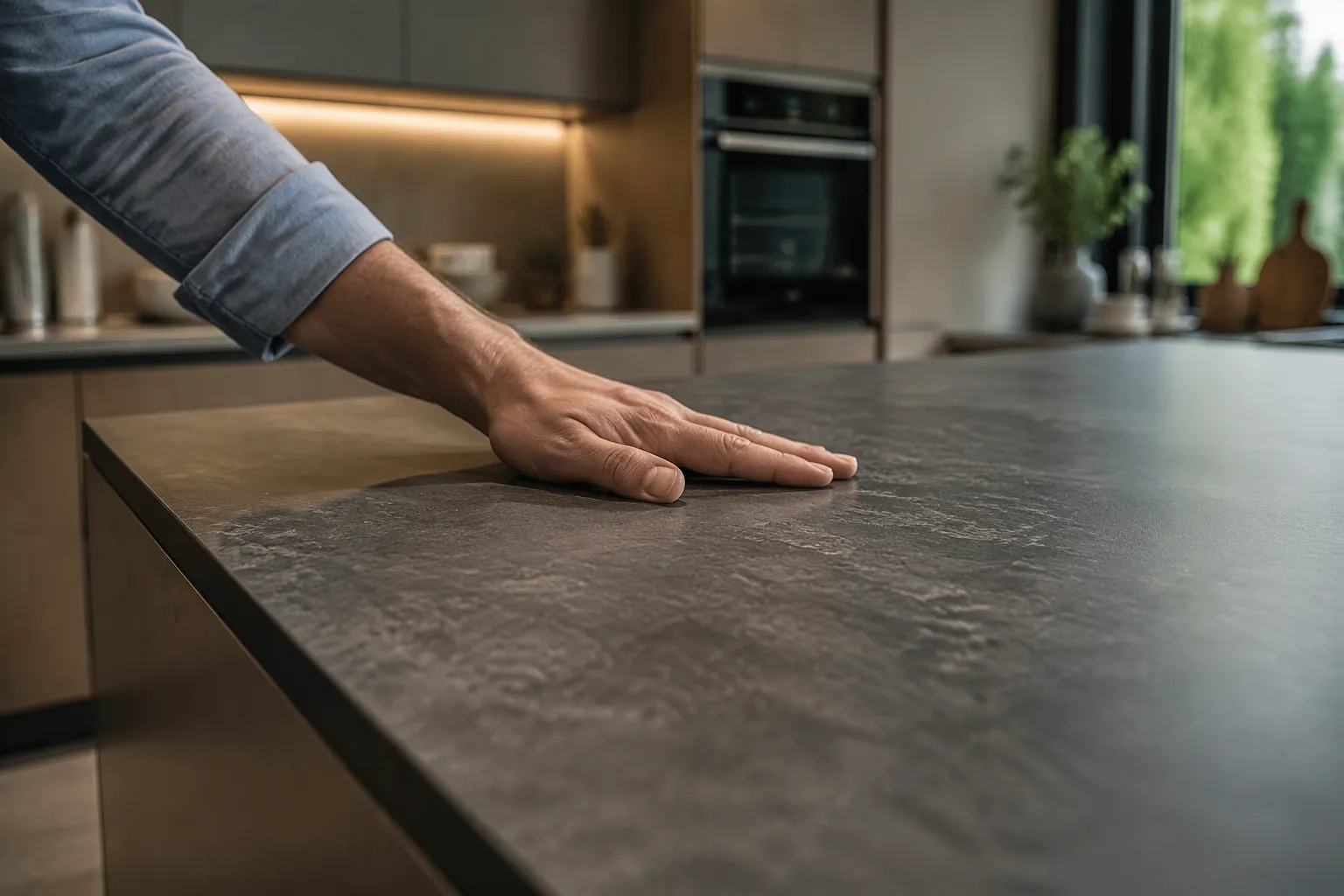
An HPL laminate sheet is a decorative surface material. It is made by bonding layers of resin-soaked paper under high heat and pressure. The name stands for high pressure laminate, a thermosetting product built for tough, everyday surfaces.
Builders, designers, and furniture makers choose HPL for one simple reason. It resists wear, moisture, and impact. It also offers hundreds of colors, woodgrains, and stone patterns. A single sheet can cover a kitchen counter, a cabinet door, or a wall panel. Installers value the predictable thickness and clean edges. That mix of strength and design freedom keeps HPL in demand across homes, offices, and public spaces.
Key Takeaways
HPL laminate sheets are strong surface materials made from paper and resin pressed under high heat.
HPL resists wear, moisture, and impact, making it great for kitchens, offices, and public spaces.
HPL comes in many colors and patterns to match different design needs.
Choose the right HPL grade for your project: thin for cabinets, thick for partitions.
HPL is easy to clean and lasts a long time with simple care.
What Is an HPL Laminate Sheet?
Definition in Plain Terms
An HPL laminate sheet is a surface material used for decoration. Manufacturers make it by bonding paper soaked in resin under high heat and pressure. This process turns soft paper layers into a hard, dense panel. The result is a thin sheet with a printed surface and a strong core.
The letters HPL stand for high pressure laminate. Industry standards define this product by its thermosetting resins. These resins cure permanently when heated. They do not soften again at normal room temperatures. That permanent cure gives an HPL sheet its stability and strength. A buyer can trust the panel to hold its shape and finish over years of daily use.
Where HPL Shows Up
People meet HPL in many everyday spaces. Kitchen countertops are a common example. The surface resists spills, heat, and knife marks. Cabinet doors and drawer fronts often carry an HPL skin. The material takes woodgrain and solid-color prints well.
Wall panels and room partitions use HPL sheets because they are easy to clean. Doors in offices and public buildings wear HPL faces for the same reason. Furniture makers apply HPL to desks, tables, and shelving. Each of these settings needs a surface that looks good and lasts. HPL meets that need in homes, schools, shops, and workplaces. Readers who spot a patterned counter or a colored cabinet door may be looking at HPL without knowing it.
What Is HPL Made Of?
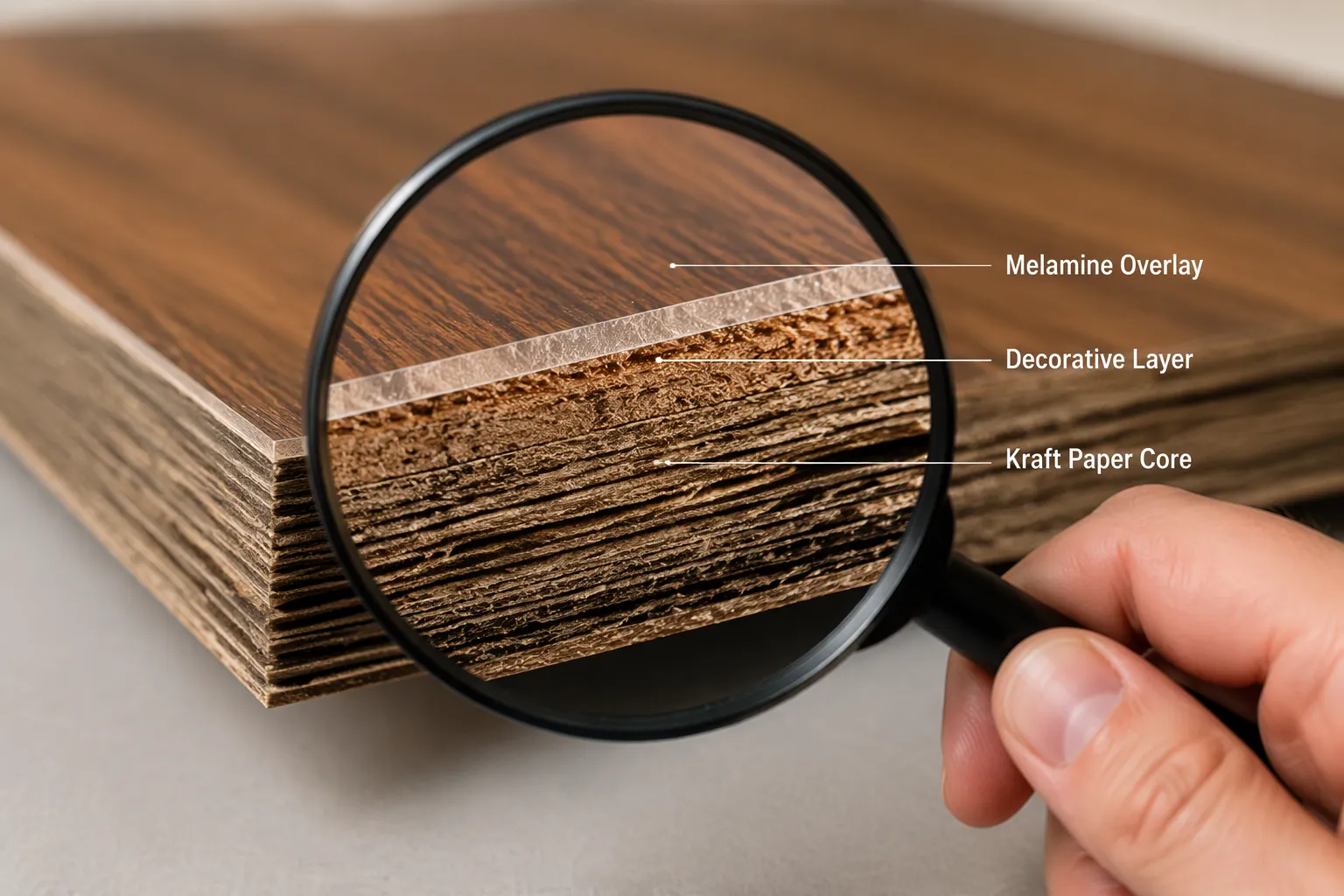
Layers of an HPL Sheet
An HPL sheet is a sandwich of paper and resin. The build starts with several layers of paper. Each layer has a job. Together they form the finished panel.
The bottom section holds the kraft paper core. This core gives the sheet its strength and thickness. Manufacturers stack six to eight layers of kraft paper here. Each sheet of kraft paper soaks up resin before stacking. The resin turns the soft paper into a hard, dense mass.
A decorative layer sits on top of the core. This sheet carries the color, woodgrain, stone look, or abstract pattern. The print is sharp and consistent across the panel. A clear melamine-resin overlay covers the print. This protective wear layer guards the design from scratches, stains, and daily wear.
The three parts work as one unit. People in the trade call them the kraft, décor, and wear layers. The finished panel is roughly 60 to 70 percent paper. The rest is thermosetting resin. That ratio explains why HPL feels dense and solid in the hand.
Core Materials and Resins
The material makeup and manufacturing of HPL depend on two resin families. Each one does a different job.
Phenolic resin soaks the kraft paper core. This resin is dark and tough. It bonds the layers of kraft paper into a single structural block. Phenolic resin also adds moisture resistance to the core. The dark color stays hidden inside the panel, so it never affects the surface look.
Melamine resin handles the top side. Melamine-impregnated décor paper forms the printed face. A second coat of melamine resin builds the clear protective overlay. This resin cures clear and hard. It resists heat, abrasion, and common household chemicals. The protective overlay fused to the décor paper keeps the pattern visible for years.
The press bonds everything together. High heat and pressure fuse the stack into one solid sheet. The resin-soaked paper layers cure under this load. The result is a panel with no weak seams between layers. Each layer of core, décor, and wear papers locks into the next.
A buyer who understands what HPL is made of can judge quality better. A thick kraft paper core signals strength. A even resin coat signals a durable face. These details matter more than the pattern alone.
How High Pressure Laminate Is Made
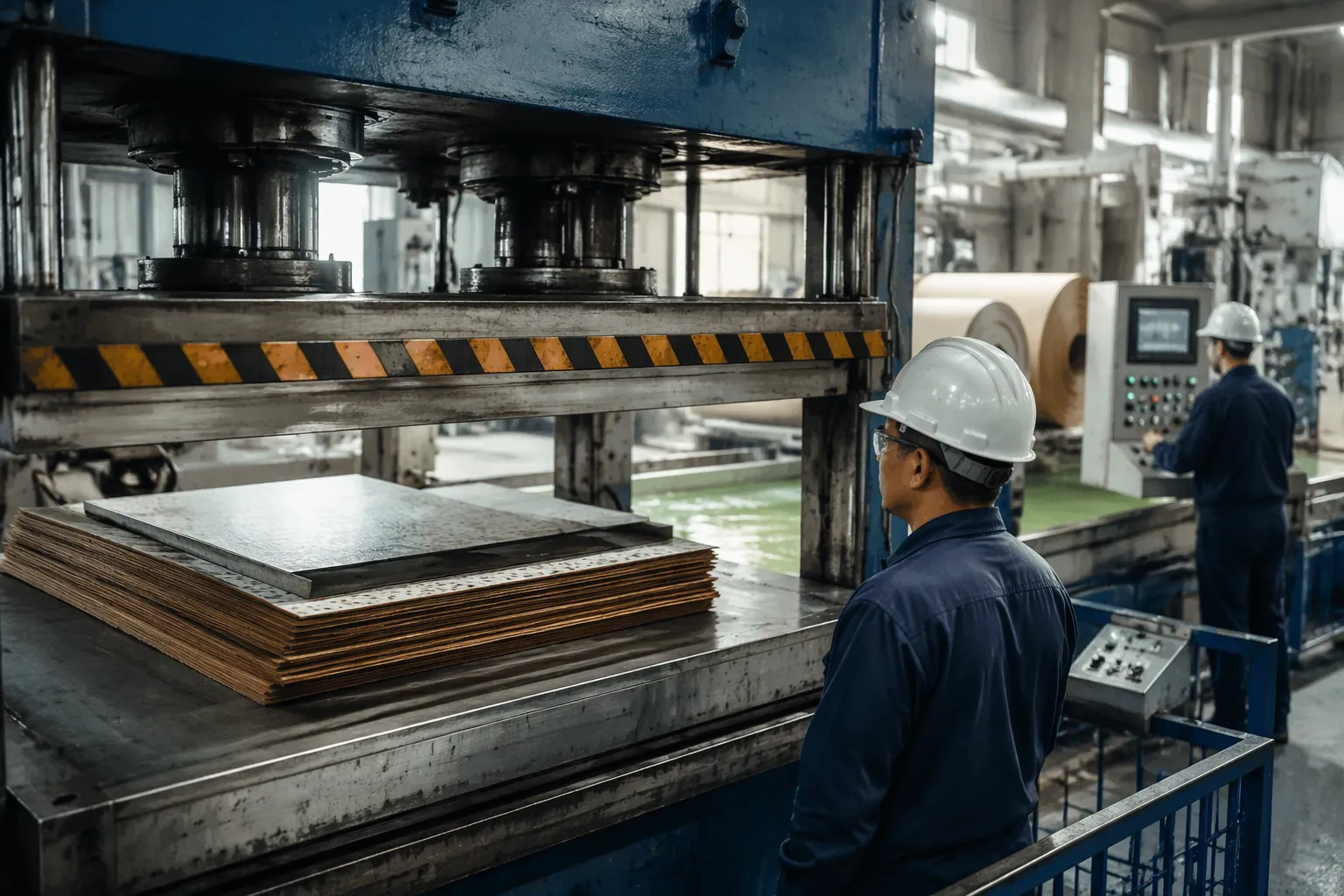
Step-by-Step Production
Making HPL follows a set order of steps. Each stage builds on the one before it. Knowing the steps helps buyers judge what a good sheet should offer, and where shortcuts show up.
Impregnation. Rolls of kraft paper and décor paper go through a bath of thermosetting resin. The paper soaks up the resin, and dryers remove extra solvent. Operators watch resin pickup closely, because too little resin weakens the core and too much makes the sheet brittle. The treated paper comes out a little tacky and ready to stack.
Stacking. Workers lay the resin-soaked kraft sheets into a bundle. They add the décor layer on top, then the protective overlay. A steel plate goes between each stack. The plate carries the surface texture, so a matte plate gives a matte HPL face.
Pressing. The stack goes into a press under high temperature and pressure. Platens heat the load to around 140 °C while pressure packs the layers together. The resin cures and fuses the paper into one solid sheet. This step defines HPL, because the high heat and pressure create the dense, hard surface. Press time and pressure settings change with panel thickness and resin type.
Cooling. The pressed sheets cool under controlled conditions. Slow, even cooling stops warping and locks in dimensional stability. A rushed cool-down can leave stress inside the HPL panel.
Trimming and finishing. Saws trim the panel edges to the target size. Brushes or rollers apply the final texture, such as matte, gloss, or woodgrain relief. Workers then inspect each HPL sheet for chips, scratches, and color drift.
Thickness changes the recipe. A thin HPL sheet for cabinet faces needs fewer kraft layers than a compact panel for a locker room. The press operator adjusts cycle time to match. Consistency across a run matters as much as any single setting.
The material makeup and manufacturing choices at each stage shape the final panel. Resin content, press time, and cooling rate all affect strength and flatness. A tight line yields consistent HPL order after order.
Finishing and Quality Checks
Finishing does not end the job. Every batch then moves through testing. Physical tests check thickness, density, and surface wear. Chemical tests confirm resistance to stains and common solvents. Fire-performance tests measure how the sheet reacts to flame and heat. A panel that fails any check does not ship.
Sampling follows a set plan. Testers pull HPL sheets from each run and record results. Records let a supplier trace any fault back to a specific batch.
Experienced makers treat these checks as routine. TRSK, for example, brings more than 24 years of high pressure laminate experience to its lines. The company holds ISO 9001 and ISO 14001 certifications, which show documented quality and environmental management. That kind of system keeps the process repeatable from one order to the next.
A buyer can ask any supplier about its testing regime. Clear answers about physical, chemical, and fire tests signal a serious operation. Vague answers deserve a second look. The press and the lab work together, and both matter for a sheet that performs in the field.
Key Properties of HPL
Durability and Resistance
An HPL sheet earns its place by standing up to hard use. The surface resists wear from daily traffic, so countertops and doors keep their finish for years. Impact resistance protects the panel from knocks and drops. Moisture resistance keeps the core stable in kitchens and bathrooms. Chemical resistance handles spills of common cleaners and solvents. These traits come from the dense build created under high heat and pressure.
Fire safety adds another layer of value. HPL carries a Class B1 fire rating, which suits spaces with strict safety demands. Dimensional stability means the panel holds its shape through humidity and temperature swings. A sheet that stays flat installs faster and looks better over time. Together, these properties explain why specifiers trust HPL in busy public buildings.
Thickness, Sizes, and Cost
Buyers can match the panel to the job. Thin grades suit cabinet faces, and thick compact grades handle partitions and lockers. Standard sizes cover most projects, and custom cuts are available. The table below lists the common specifications.
Property | Typical Value |
|---|---|
Thickness | 0.5–25 mm |
Standard size | 1220 × 2440 mm |
Density | ≥1450 kg/m³ |
Water absorption | ≤8% |
Cost tracks thickness and design. A thin sheet costs less than a compact panel of the same pattern. Standard sizes usually offer the best value per square meter.
Sustainability matters to many buyers. FSC-certified timber and low VOC emissions make HPL a greener choice for indoor projects. TRSK High Pressure Laminate comes in more than 1000 designs, with widths of 1220mm, 1300mm, 1525mm, and 1830mm and lengths up to 4270mm. The company also offers OEM/ODM support for custom colors, patterns, and thicknesses.
HPL Types, Uses, and Alternatives
Grades, Applications, and Care
HPL comes in a few grades, and each one is made for a different job. Standard HPL works well for cabinet faces, furniture, and wall panels. Postforming HPL bends when heated, so it wraps around curved edges and tabletops without a visible seam. Compact HPL is full thickness and can stand alone as a structural panel for lockers, partitions, and restroom stalls. Chemical-resistant HPL is used in laboratories, hospitals, and salons. Exterior cladding resists UV light and boiling water for outdoor walls. Solid core HPL shows a decorative core on the edge, which works well for desktops and counters.
How you install it depends on the grade. Thin sheets stick to a substrate with contact adhesive or press lamination. Compact panels attach to frames with mechanical fasteners. Care is simple for every type. Wipe the surface with a damp cloth and mild detergent. Stay away from abrasive pads and strong solvents on the decorative face. Cleaning spills right away protects the finish over years of use.
HPL vs. Melamine, MDF, and Veneer
Each surface option fits a different budget and setting. Melamine laminate uses a similar printed paper face, but it bonds to a particleboard core instead of curing as a stand-alone sheet. Melamine works for low-traffic furniture and shelving where cost matters most. MDF gives you a smooth, even board that machines and paints well, which makes it a favorite for painted cabinets and molded profiles. Veneer brings real wood grain and a natural feel, and it fits fine furniture and feature walls where real timber looks lead the design.
HPL sits between these choices on cost and above them on surface toughness. The high heat and pressure used in production create a dense face that resists wear, moisture, and chemicals. A high pressure laminate sheet also works in wet or public spaces where melamine and MDF fall short. TRSK High Pressure Laminate covers more than 1000 designs across standard, postforming, compact, chemical-resistant, cladding, and solid core lines. Each option has a place, and the right pick depends on traffic, moisture, and the look a project needs.
An HPL laminate sheet is a decorative surface made from resin-soaked paper fused under high heat and pressure. This guide has covered its layered makeup, the pressing process that gives it strength, its resistance to wear, moisture, and fire, and its many uses in homes and commercial spaces.
A helpful tip here is to match the grade to the job. Thin HPL sheet grades work well for cabinet faces, while compact panels handle partitions and wet areas. Readers who think about traffic, moisture, and design needs will know if HPL fits their project. This complete guide gives them the facts to decide with confidence.
FAQ
What does the abbreviation HPL stand for?
HPL stands for high pressure laminate. The name tells you how it is made. Makers press layers of paper soaked in resin under high heat and pressure. That pressing step gives an HPL sheet its dense, hard surface.
How does HPL differ from melamine?
Melamine glues a printed face onto a particleboard core. An HPL sheet hardens into a stand-alone panel with its own kraft core. This build gives HPL more resistance to wear, moisture, and chemicals. Melamine works for lighter-duty furniture at a lower cost.
Does HPL handle moisture and heat well?
Yes. The phenolic resin core keeps water absorption at or below 8 percent. HPL panels hold their shape in humid rooms such as kitchens and bathrooms. A Class B1 fire rating adds safety for public and commercial spaces.
Can buyers order custom sizes and designs?
Many suppliers offer customization. TRSK High Pressure Laminate carries more than 1000 designs across several widths and lengths. The company supports OEM/ODM work for colors, patterns, and thicknesses. A typical minimum order is 100 sheets, with delivery in 15 to 20 days.
Where does HPL work best?
HPL fits high-traffic and wet settings. Common uses include kitchen countertops, cabinet faces, wall panels, partitions, and laboratory benches. Thin grades suit furniture, and compact grades handle lockers and restroom stalls. Matching the grade to the job gives the best result.